Face Behind the Course: Meet Ridwan Abukari

How can development be understood beyond mainstream theories and global assumptions? We sat down with Ridwan Abukari, a doctoral researcher from the University of Jyväskylä and the teacher for the UniPID MOOC course, Essentials in Development Studies to discuss this and beyond.
Bringing local realities into development education
For Ridwan Abukari, development studies is not only about learning theories or understanding global trends. It is about questioning whose knowledge counts, whose voices are heard and how development can be understood through the lived realities of different communities.
A doctoral researcher in Development Studies at the University of Jyväskylä, Ridwan’s work is informed by critical theories of power and intersectional perspectives on gender, inequalities, citizenship, peace, conflict, and social justice, particularly within African contexts. His research examines how vulnerable communities negotiate citizenship from the margins, focusing on the lived experiences of alleged witches in Northern Ghana. He was awarded the UniPID-FSDR Annual Master’s Award in Development Studies in 2025.
Ridwan’s decision to teach stems from a desire to create a learning environment where participants can critically engage with development theories while connecting them to local realities. Grounded in African-centred epistemologies, he believes that “development interventions often fail when they overlook the agency, culture, historical experiences, and everyday realities of the communities they seek to support.”
Through his teaching, he encourages students to examine development challenges from multiple perspectives and to appreciate voices and experiences that are frequently underrepresented in global discussions, particularly those from the Global South.
Learning through diversity and dialogue
One of the most rewarding aspects of teaching for Ridwan has been engaging with students from different countries, disciplines, and backgrounds. He sees the diversity of experiences that participants bring to the classroom as a valuable resource that enriches discussions and challenges preconceived viewpoints: “These interactions create a genuinely collaborative learning environment where students and teachers alike can broaden their understanding of complex social issues.”
The cross-cultural nature of UniPID courses also offers opportunities to build meaningful social and professional networks. By connecting learners from different institutions and regions, the courses create spaces where knowledge can be exchanged across borders and where new perspectives emerge through respectful dialogue.
Developing critical and socially just perspectives in a changing world
To stay up to date with emerging debates and developments in development studies, Ridwan regularly engages with peer-reviewed research, interdisciplinary research groups, conferences, webinars, and professional networks.
At the heart of his engagement is commitment to critical reflection. For Ridwan, the most important outcome of the course is not simply acquiring knowledge but developing the ability to think critically, engage with different knowledge systems, and approach global challenges with curiosity and openness.
At the same time, he encourages participants to approach development issues through locally grounded and socially just perspectives. By adopting multidisciplinary approaches and recognizing the diverse interests of stakeholders, students can become better equipped to contribute meaningful solutions to complex development challenges.
For future UniPID students
Having taken UniPID Virtual Studies himself, he encourages students to actively participate, stay curious, and be ready to have their assumptions challenged.
“One of the most valuable aspects of the courses, he notes, is the opportunity to engage with participants from different universities, academic fields, and countries. These interactions often become one of the most memorable and rewarding parts of the learning experience.”
For Ridwan, global development is ultimately about learning from and understanding others. “There is no universal solution to development challenges. Instead, meaningful and inclusive development emerges when diverse experiences, local contexts, and multiple forms of knowledge are valued and brought into conversation with one another.”
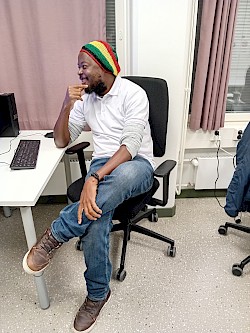 Ridwan Abukari is a doctoral researcher in Development Studies at the University of Jyväskylä. His research focuses on citizenship, inequalities, social justice, and marginalised communities, with a particular emphasis on African contexts. He teacher on UniPID’s Essential in Development MOOC, where he encourages students to critical reflection, multidisciplinary thinking, and more inclusive approaches to development research and practice