Can COIL create a more level playing field? Exploring epistemic justice in North–South collaboration

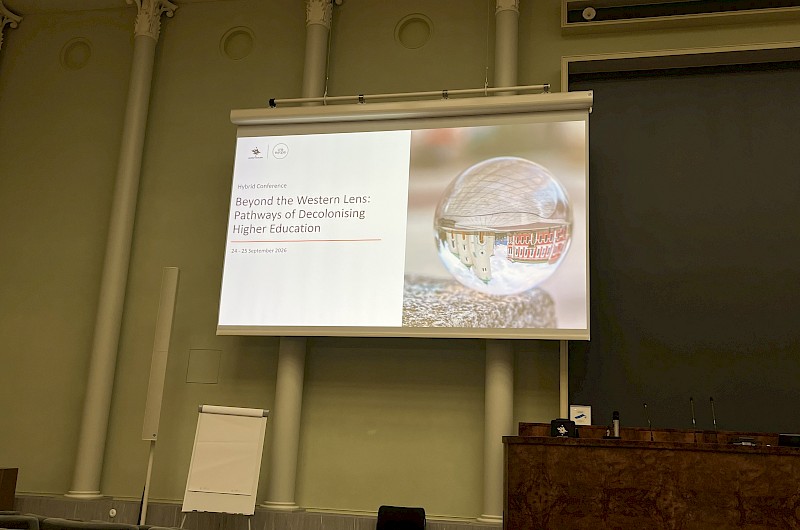
UniPID participated in the Southern African-Nordic Centre Conference SANORD 2026 hosted by the University of Namibia in Windhoek on 21-25 September. The conference was hosted under the theme “Reimagining Knowledge for Shared Development” and invited participants to explore how partnerships between Global South and North could lead to shared development and just and sustainable futures.
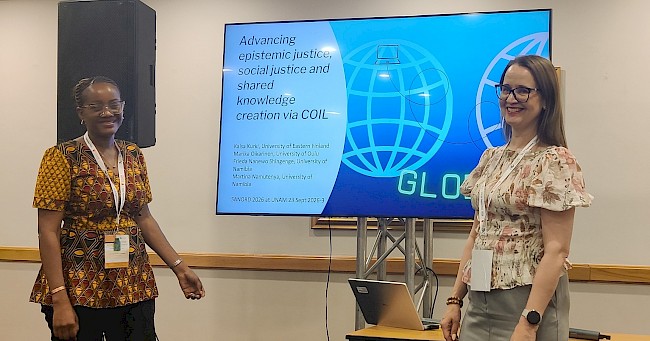
Team Finland Knowledge project Globus, led by UniPID at the University of Eastern Finland, was presented in two different sessions. Project partners Dr Lavern Samuels and Mandisa Kamwendo from the Durban University of Technology presented the project as a driver for inclusive academic collaboration in Southern African and Nordic Regions. GLOBUS team members Kaisa Kurki, UniPID; Frieda Shingenge, University of Namibia; Marika Oikarinen, University of Oulu, and Martina Namutenya, University of Namibia, collaborated in examining how the presence of epistemic justice is perceived in North-South COIL collaborations.
The presentation given by Frieda Shingenge and Kaisa Kurki introduced Collaborative International Online Learning (COIL) that is increasingly recognised as a pedagogy to make international learning more accessible than traditional student mobility. By connecting students and teachers across countries in shared learning environments, COIL can bridge geographical and cultural distances and create opportunities for intercultural learning. Could COIL also contribute to greater epistemic justice in collaboration between universities in the Global North and Global South?
Creating space for different ways of knowing
The research project asks how academics involved in North–South COIL collaborations perceive epistemic justice and how knowledge creation could become more inclusive by recognising Southern, Indigenous and context-specific knowledge. Our preliminary findings, based on interviews with academics involved in North–South COIL collaborations, suggest that equity does not emerge automatically in a virtual classroom. It needs to be intentionally built into the collaboration. This begins with joint planning. Teachers as well as students need time to understand each other's contexts and jointly define objectives and learning outcomes. Trust, openness and acceptance between teaching staff are therefore fundamental.
COIL can also shift the traditional teacher-student relationship. Teachers become facilitators while students engage with different lived experiences and construct knowledge together. As one interviewee explained, in COIL, “students … actually take charge.” Yet existing power relations remain present. Acknowledging such inequalities is essential if COIL is to become a space where different forms of knowledge are genuinely valued rather than simply brought together.
Technology both connects and divides
Digital learning illustrates another tension. COIL can overcome geographical and financial barriers and enable students who might never participate in physical mobility to gain an international learning experience. At the same time, unequal connectivity, access to paid tools and differences in institutional resources can reproduce existing inequalities. Technology can flatten the boundaries, but only when differences in access are consciously addressed.
The experience can also be transformative for teachers. One interviewee described continually reconsidering their teaching through COIL:
“Our pedagogy is required to be re-looked and after every COIL, I revisit it and say, how does this change me?”
A level playing field is a journey
Our emerging findings indicate that COIL can make internationalisation more inclusive and international partnerships more tangible. Virtual collaboration can also provide a foundation for research cooperation, exchanges and longer-term academic relationships. But COIL is not automatically equitable. Academic calendars, workloads, large class sizes, digital inequalities and deeper North–South power asymmetries all shape the learning environment. Institutions must therefore provide time, training and structural support for meaningful collaboration:
“COIL actually takes you to a place where you're on the level playing field. But … it's a journey to get there.”
Our tentative conclusion is therefore that COIL can provide a practical space for advancing epistemic justice, but only when the collaboration deliberately addresses whose knowledge is recognised, whose circumstances shape the learning environment and how knowledge is created together. The future of internationalization from the perspective of equity and access demands going beyond performative gestures towards authentic encounters of individuals and institutions.
Cover photo by Ashim D’Silva on Unsplash.