Ridwan Abukari from the University of Jyväskylä selected as the winner of the Master’s Award in Development Studies 2025

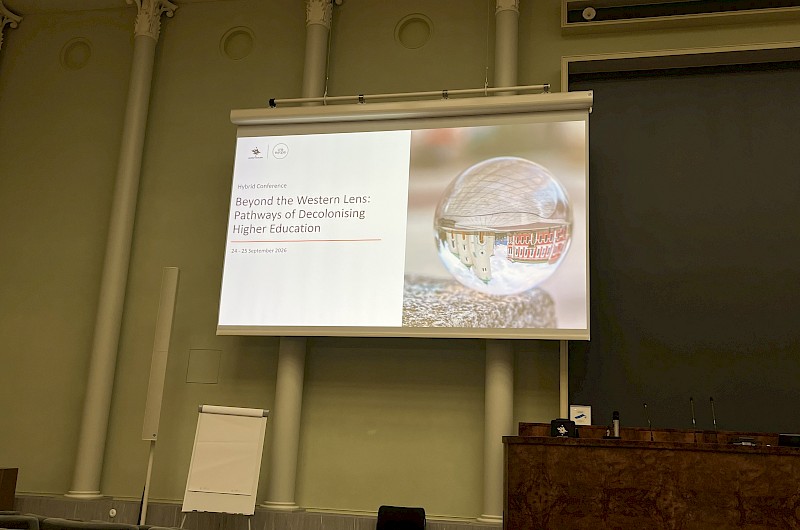
As part of the Development Days Conference 2026 programme, the winner and honorary mentions of the Master’s Award were announced. Abukari was selected as this year’s winner for his thesis examining witchcraft accusations in Northern Ghana. Topics such as futures studies, energy transition, governance and participation, green architecture, and gender studies were also represented among the theses recognized in the final evaluation round.
Each year, UniPID and the Finnish Society for Development Research (FSDR) present the Master’s Award in Development Studies to highlight exceptional theses within the field of global development studies. The award supports interdisciplinary research conducted across UniPID member universities, promoting academic excellence and encouraging critical engagement with urgent global issues.
The Master’s Award in Development Studies 2025 was granted during the Development Days 2026 conference program at the University of Helsinki. This year, the recipient was Ridwan Abukari from the University of Jyväskylä for his thesis “Gendered Injustice? Power Analysis of Witchcraft Accusations in Northern Ghana.” The final evaluation committee commended the thesis for its rigorous and well‑designed fieldwork, as well as for the author’s thoughtful reflexivity regarding positionality and research ethics.
“Abukari’s thesis offers a compelling and well‑documented analysis of witchcraft accusations in Northern Ghana, highlighting their profound gendered impacts. This thesis makes a valuable contribution by revealing the complexity of these accusations and offering important perspectives for future interventions that support affected women and challenge harmful practices.” The final evaluation committee said.
Master’s Award ceremony recap
The Master’s Award ceremony opened with remarks from Ana Tarazona, Virtual Studies Coordinator at UniPID and secretary of the Master’s Award working group. In her address, Tarazona emphasized the wide range of perspectives and themes emerging from the Global South in this year’s submissions, noting that through diverse lenses, disciplines, and topics, master's students are collectively enriching the field of Development Studies.
Following the opening remarks, Liisa Laakso, chair of the final evaluation committee, announced the honorary mentions and revealed this year’s winner.
Ridwan Abukari, who joined the ceremony online from Ghana, offered a brief speech reflecting not only on his thesis-writing journey but also on the broader significance of his work for the development sector.
Abukari expressed: "This work contributes to shaping the broader debates on power, stigma, social exclusion and marginalisation in contemporary contexts. Tonight, as I receive this award, I cannot help but think of those women whose stories rarely enter rooms like this. I am deeply aware that the stories that shaped this thesis came from women whose voices are often silenced.
This recognition belongs not only to me, but to them, and other women who suffered witchcraft-related abuses over the years in Ghana. May the findings of this thesis contribute meaningfully to national and international conversations on policy, good governance and development.” Ridwan Abukari
Honorary mentions were also awarded to the five theses that, together with the winner’s work, advanced to the final evaluation round. The following theses were recognized:
|
Name |
University |
Thesis title |
|
Emilia Sundqvist & Merika Mattila |
Aalto University |
|
|
Iida Vedenpää |
University of Jyväskylä |
Post-Disaster Women Empowerment: A Narrative Analysis of Relief Workers' Perspectives |
|
Lahara Ranaweera |
University of Turku |
Preferred Futures of Development Cooperation for Finland in 2040 |
|
Mariel Kieval |
University of Helsinki |
From Sea to Steppe: Perceptions of the Energy Transition Across Kazakhstan's Petrostate |
|
Ruchira Liyanage |
Tampere University |
Developing a Framework for Formulating Building Archetypes for Finnish Residential Buildings |
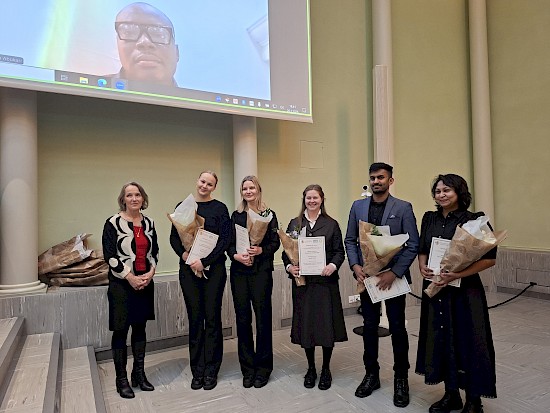
In the photo: Ridwan Abukari online; from left to right: Liisa Laakso, Merika Mattila, Emilia Sundqvist, Mariel Kieval, Ruchira Liyanage, and Lahara Ranaweera.
The People and Process Behind the Master’s Award 2025
This year, 33 theses were submitted to the Award, representing not only a broad range of universities but also a rich diversity of multidisciplinary programmes and approaches within Development Studies. The theses were first reviewed by a professional pre-selection committee composed of 16 doctoral and postdoctoral researchers affiliated with the UniPID Doctoral Network (DocNet).
We extend our sincere appreciation to Jamile Teles, Lasse Antero Lampinen, Abraham Openy, Pooja Majunath, Raihanatul Jannat, Meysam Abedi, Johanna Kettunen, Katariina Murtolahti, Ida Herdieckerhoff, Angelica Conti, Henna Rinta‑Kiikka, Polina Kalnitskaya, Benta Mbare, Wissam Saleh, Noor Jahan Punam, and Syed Musa Nuri for their meticulous and dedicated work in undertaking the demanding task of selecting the six strongest theses to advance to the final stage.
Subsequently, the final evaluation committee, chaired by Liisa Laakso, Emnet Woldegiorgis, and Antti Erkkilä, engaged in careful assessment and thoughtful deliberation before selecting the winner and the honorable mentions.
Both committees faced a particularly challenging task due to the consistently high quality of the submissions, reflected in their rigorous methodologies, well-executed fieldwork, and strong analytical contributions.
UniPID celebrates the achievements of the winner and finalists and expresses deep appreciation to every participant, evaluator, and member university involved in making this year’s competition possible.
What’s next? The call for applications for the Master’s Award 2026 will open in late spring—stay tuned for updates! In the meantime, you can learn more about previous award recipients here: https://www.unipid.fi/for-society/masters-award/
Photo credits: Diana Polekhina, 2021 on UnSplash