UniPID and FINGO explored multistakeholder perspectives on climate change education at GEP 2026
UniPID and FINGO collaborated in organising two sessions at the annual Global Education Partnership (GEP) Forum in Helsinki on 29 October. Both sessions focused on the potential of multistakeholder collaboration and bringing together perspectives from academic and civil society for solutions.
From awareness to action: building climate resilience through education and partnership
How can climate education move beyond raising awareness to help communities prepare for an increasingly uncertain future? This question brought together experts from civil society, academia, and public policy at the Global Education Partnership Forum 2026 session Exploring Multistakeholder Perspectives on Climate Change Education for Resilience, jointly organized by the Finnish University Partnership for International Development UniPID and Fingo, the umbrella organisation of Finnish CSOs engaged in development cooperation, sustainable development and global citizenship education.
The session explored a simple but powerful idea: climate change education is most effective when different sectors work together. Researchers, educators, policymakers, communities, and civil society organizations each hold part of the solution. Building climate resilience requires connecting these perspectives rather than allowing them to remain in separate silos.
Climate education starts in communities
The first presentation brought participants to school communities in Uganda through the work of Glory Angeyo Oyet, Regional Project Manager at Finn Church Aid. Drawing on practical experiences from schools and teacher training programmes, the presentation demonstrated how climate education can become part of everyday learning. Teachers were supported in integrating environmental themes into classroom subjects, while students engaged in hands-on activities such as school gardening and waste management initiatives.
These examples highlighted that effective climate education is not limited to teaching scientific facts. It also equips learners with practical skills, encourages responsible environmental behaviour, and strengthens communities’ capacity to respond to climate-related challenges. In fragile contexts, where climate shocks can disrupt schooling and livelihoods, such skills become an important foundation for resilience.
Preparing teachers for climate change education
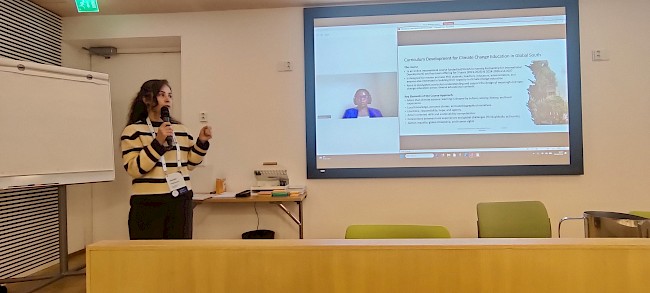
The second speaker, Golaleh Makrooni from the Finnish Institute for Educational Research, University of Jyväskylä, and Tampere University, examined the role of curriculum development and teacher education in climate change education. Although climate change is increasingly recognised as a critical educational topic, significant gaps remain between policy aspirations and classroom practice. Studies indicate that many teachers do not yet feel sufficiently prepared to teach climate-related topics with confidence.
Makrooni introduced the UniPID Virtual Studies course Curriculum Development for Climate Change Education in Global South that takes a holistic approach to climate education by combining scientific understanding with cultural perspectives, personal experiences, emotions, responsibility, hope, and agency. Participants from a wide range of countries and educational backgrounds explore how climate change can be taught in ways that are locally relevant and action-oriented.
Drawing on collaboration with Indonesian teachers and researchers, Makrooni highlighted the value of narrative and autobiographical approaches that connect climate issues to learners’ everyday realities. Such methods help move climate education from abstract knowledge towards meaningful engagement and action.
The role of higher education was explored by Laura Riuttanen, University Lecturer at the University of Helsinki and Coordinator of the Climate University network. The network brings together Finnish higher education institutions to develop climate and sustainability education and to make high-quality learning opportunities widely accessible.
Climate University offers a diverse portfolio of open courses covering themes such as climate science, biodiversity, circular economy, planetary health, sustainable consumption, climate communication, and systems change. The network demonstrates how universities can collaborate across institutional boundaries to respond to society’s growing need for climate expertise.
Riuttanen also presented the Specialisation Programme in Climate Expertise, a research-based continuing education programme designed for professionals working across sectors. The programme aims to transform climate knowledge into practical climate agency by connecting research, professional practice, and cross-sectoral collaboration.
Climate education as part of national resilience
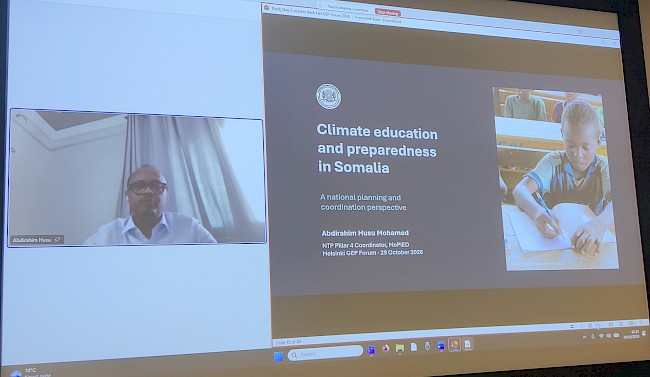
Providing a policymaker’s perspective, Abdirahim Husu Mohamed from Somalia’s Ministry of Planning, Investment and Economic Development emphasised that climate change is not only an environmental challenge but also an educational one. Climate shocks such as floods and droughts can interrupt learning, damage school infrastructure, and increase educational inequality.
From the perspective of Somalia’s National Transformation Plan, climate education should be closely connected to preparedness and adaptation efforts. Mohamed argued that education systems must help individuals understand climate risks while also ensuring that schools and communities are equipped to continue functioning during climate-related disruptions. Preparedness, continuity of learning, and climate awareness should therefore be planned together rather than as separate policy areas.
A particularly important message concerned climate justice. Effective climate education must recognise that communities experience climate risks differently and have unequal capacities to respond. Policies should therefore prioritise inclusion, accessibility, and local knowledge, ensuring that vulnerable groups are not left behind.
Breaking down silos
Despite approaching climate education from very different perspectives, all speakers returned to a common theme: the need for stronger collaboration. Civil society organisations bring practical experience from communities. Universities contribute research, curriculum development, and teacher education. Policymakers create frameworks that enable long-term implementation and scaling. When these actors work together, climate education can become a powerful tool not only for increasing awareness but also for building resilience and supporting sustainable development. As climate impacts continue to intensify globally, the message from the session was clear: climate education must go beyond information sharing. It should empower learners, strengthen communities, and create pathways for collective action. Achieving this requires partnerships that bridge sectors, disciplines, and geographical contexts, turning climate knowledge into resilience and preparedness for the future.